

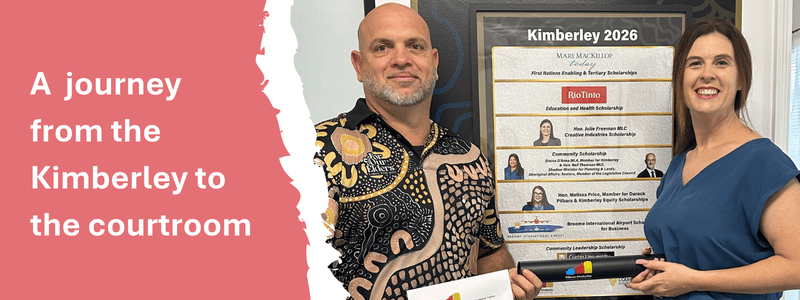
Cameron grew up deep in the Kimberley, in a world where tertiary education was not part of the story people told about themselves. At 15, he was out on the cattle stations – the path that generations of Aboriginal men before him had followed, shaped by a belief that certain doors simply weren’t open to them.
Today, Cameron is a scholarship recipient with Mary MacKillop Today’s First Nations Scholarship Program, studying paralegal studies through the Pilbara and Kimberley University Centres (PKUC). He is a father of two, a former Department of Justice Program Officer, and a man with a very clear sense of where he is going, and why.
His story is not a story about charity. It is a story about what becomes possible when the right support meets the right person at the right time.
From the cattle stations to the courts
Cameron spent five and a half years working as a Program Officer at West Kimberley Prison, running criminogenic treatment programs with men experiencing family and domestic violence and drug and alcohol issues. He worked on the perpetrator side, trying to make change from the inside, in one of the most under-resourced corners of the justice system.
What he saw there shaped his next step. Approximately two-thirds of the prison’s inmates were on remand, some waiting up to 18 months to be sentenced. Without a sentence, they couldn’t access rehabilitation programs. They sat, largely unoccupied, while a clogged court system worked through its backlog.
“The dream is to work with the courts, trying to unblock the system, trying to assist where I can. As an Aboriginal person from up in the Kimberleys, I would be able to work with the courts get the background information that magistrates need to make their determinations. The dream is to be that connector between the court and the people.”
Now in a new role with the Department of Communities – child protection – Cameron is building a picture of both sides of the justice equation. It is deliberate. He wants to understand the whole system before he tries to make a difference.
Making it work from 2.5 hours from Broome
Cameron lives in a small town two and a half hours north of Broome. The nearest university campus, the services most people take for granted, the reliable internet connection, none of these are close.
He studies online through the University of New England, which is based in New South Wales. That means navigating a two-hour time difference, patchy connectivity, and no access to physical library resources. He does all of this while working full time, parenting two young boys, and managing household finances on a single income in one of the most expensive regions in Australia.
“The cost of living up here is astronomical. Just coming across to Broome, it’s a planned thing now because you know it’s going to hit the wallet. These sorts of scholarships just make a world of difference. It takes the edge off the burden.”
The scholarship from Mary MacKillop Today covers just a fraction of the cost for Cameron. But it eases the financial pressure that bleeds into everything – family time, relationship stability, the simple ability to show up fully to his work and his studies without constantly robbing one commitment to fund another.
“What it would do for me is relieve some of the financial stress. Things like this stretch a long way. It helps with relationships. Financial stress is a big thing on relationships.”
Responsibility as a calling
Cameron does not describe himself as a leader in the traditional sense. He is careful about that. But he talks about responsibility the way some people talk about faith, as something that sustains him, shapes his choices, and makes him better.
“I feel men need more responsibility. It’s actually a saving grace. That’s my theory – it’s what keeps us going. I think responsibility is a good thing.”
He wants his sons to see him take on hard things. He wants his grandmother to be proud. He wants the community he came from, and the wider Kimberley, to have one more person working from the inside to make things fairer.
“I’m not a very self-centric person. I don’t have that drive for things for myself. My thing is around my people and having a crack. I want my son to see me have a go at some hard things and help others. That shapes him as a person – what sort of man I want him to be.”
In five to ten years, he pictures himself running a consultancy, sitting in the middle of the justice system, connecting victims, perpetrators, courts, and communities. Not as an outsider proposing solutions, but as someone who has lived and worked across every part of the picture.
“I’d love to be the glue guy in the middle. You have the victims on one side, the perpetrators on the other, there’s normally a segregation. I’d love to go in between those and make the justice system work better. If I can be that guy in the middle, that’s where I’ll be in five to ten years.”
What walking alongside actually looks like
Cameron’s message to donors who make these scholarships possible is characteristically direct:
“What might seem like a little to some, it’s a lot for us up here. We are trying to make a difference. There are good people wanting to have a go – but without the necessary support, we can’t do much. We only have our effort, our character. And thanks to your organisation, it helps us help.”
The Pilbura and Kimberley University Centres exist precisely to support people like Cameron, to make tertiary education accessible in regions where the barriers are structural, geographic, and financial all at once. Mary MacKillop Today’s First Nations Scholarship Program is one part of the scaffold that holds that possibility open.
Cameron is not waiting for someone to solve the problems he sees every day. He is studying. He is working. He is showing up for his community, for his sons, and for the version of the Kimberley he believes is possible.
In the spirit of Saint Mary MacKillop, who never waited for permission to act, that is exactly the kind of courage we are here to walk alongside.
Support the next Cameron
Your donation to Mary MacKillop Today’s First Nations Scholarship Program can provide financial support to Aboriginal and Torres Strait Islander students pursuing tertiary education in remote communities across Australia.