

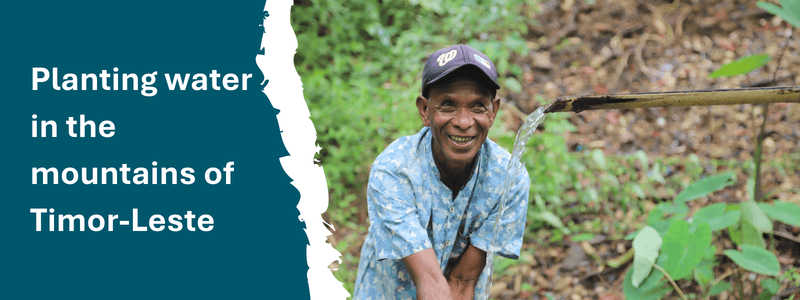
How families in Timor-Leste are securing their fresh water spring and leading the way for their children
In the highlands of Timor-Leste, life is shaped by a hard geography. Family homes have been built on the ridges, while the springs sit far below. For as long as anyone can remember, the dry season from August to November drained those springs to a trickle. People walked more than a kilometre downhill, queued from before dawn, and carried heavy 20-litre containers back up the slopes.
The cost of that daily search fell most heavily on women and girls. Mothers set out early, often carrying a baby on one hip and a water container on the other. Children didn’t attend school because they had to help fetch and carry water. When a shared spring ran low, disputes broke out among resident who all depended on the same slow trickle.
Today, that story is changing and the people of Railaco, with the support from Mary Mackillop Today and partners TILOFE, are the ones changing it.
A simple idea, led by the community
Through the Sustainable Agriculture and Women’s Empowerment project, the first initiative under Mary MacKillop Today’s new five-year Livelihoods Program, farmers across several mountain communities are being educated on how to hold water in the land itself. Working together with the support from our program partners, they dig infiltration trenches and recharge pits along the hillsides. Instead of racing downhill and washing away precious soil, rainwater now pools, slows, and seeps underground, recharging the springs that families rely on.
The technique is deliberately simple. As one farmer explained, it costs little more than a few days of shared work and a great deal of patience. What it asks in return is trust, and, at first, not everyone had it.
Rui admits he opposed the idea outright. He could not see how digging trenches would bring more water. But once the training had been implemented, he decided to try. “After one year, the results clearly showed that the water volume had indeed increased,” he says.
Springs returning, life easing
The results have come faster than many expected. Within a single year, springs that once failed in the dry season now flow steadily through August, September and beyond. In Leburema, community members count around 15 water sources that have emerged. Households that once queued at a single spring now draw water close to home.
The everyday difference is profound. Children can go back to being children, No longer responsible for their families water they have time to go to school and bathe beforehand. Coffee, the region’s livelihood, is now processed locally. For Lourenca, a widow who once fetched water from over a kilometre away, having her own reliable source has changed daily life entirely. And with less runoff tearing down the slopes, the land itself is steadier and better protected against erosion and flooding.
For Recardina, 22 and the eldest of seven children, the change is measured in something quieter than statistics. Where the daily walk for water once shaped every hour, she says simply, “We no longer feel the sadness.”
Water the community owns
What makes this work last is that it belongs to the community. In the village of Samalete, more than 30 people contributed to the effort, some with labour, others with 10 or 20 dollars towards pipes, sand and cement. The work is grounded in the Timorese practice of hamutuk, mutual help, and guided by tara bandu, the customary rules that protect land and water for everyone. Decisions about where to dig begin with the landowners and with respect for the natural features of each site.
That sense of ownership is the point. As Jacinto, puts it, the community can now manage its own resources, a quiet expression of ukun rasik, self-determination. Mary MacKillop Today, he reflects, could not be repaid in gold or silver. “They may not have given us money,” he says, “but they gave us something even more valuable, they gave us water.”
For Leonel, the gift reaches beyond his own lifetime. This, he says, is “planting water for future generations”, for the children and grandchildren who will one day draw from the same springs.
In the spirit of Saint Mary MacKillop, this is what walking alongside communities looks like: practical, shared and enduring. The springs of Railaco are flowing and now they are in the community’s own hands.
You can help more families in Timor-Leste secure reliable water for generations to come. Donate today.
Sign up to our newsletter to follow the Sustainable Agriculture and Women’s Empowerment project and other projects from Mary Mackillop Today.