
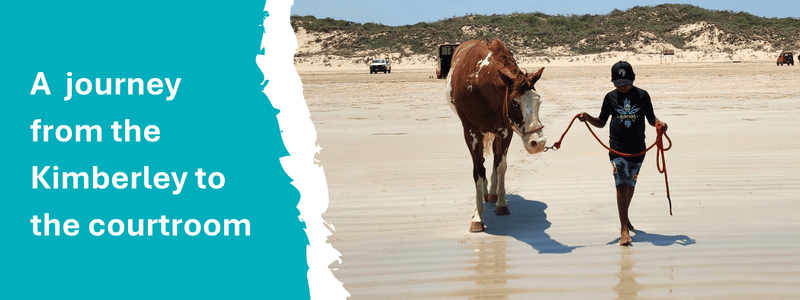
In the Kimberley region of Western Australia, a place of vast red plains, ancient saltpans, and sky that stretches further than you can imagine, something quietly extraordinary is happening. Young Aboriginal people, aged six to 25, are walking into paddocks with horses, and beginning to heal.
This is Yawardani Jan-ga. Translated from Yawuru, the name means horses helping. And in a region where First Nations people make up over 40% of the population and where disengagement from education is not a personal failing but a systemic reality, shaped by generations of inequity, this program is quietly changing lives.
This NAIDOC Week, as we celebrate the theme “50 years of Deadly”, Mary MacKillop Today is proud to stand alongside the Yawardani Jan-ga program as a long-time partner. We spoke with its founder, Professor Juli Coffin, and documentary filmmaker Sean O’Reilly, whose film about the program, Guided by Horses, is due for release in September 2026, to understand what makes this program so powerful, and why the Kimberley is calling the world to pay attention.
Born from a belief that something was missing
Professor Juli Coffin has spent decades working in wellbeing and health research with Aboriginal communities and for much of that time, she felt an unease she could not quite name.
“The programs that were being run for our Aboriginal young people really just weren’t hitting the mark. There was something missing, particularly around that investment in preventative wellbeing,” she said.
That conviction grew into action when Juli moved to the Kimberley in 2016. Already a trained equine-assisted learning (EAL) psychotherapist through the EAL Institute of Australia, she saw the potential for horses to offer something that traditional programs could not: a non-verbal, non-judgmental space for young people to reconnect with themselves.
She tried for four years to secure funding. It was Mary MacKillop Today who came first. “Mary MacKillop Today were one of the most decent backers for that project. You guys came in first off the rank to really support the idea and give it a go, which is just what I needed to get it off the ground.”
That initial backing has grown into a genuine partnership, one that has helped Yawardani Jan-ga reach more than 3,500 young Aboriginal people across the Kimberley and Pilbara, with outreach to communities including Port Hedland, Derby, Fitzroy Crossing, and Halls Creek.
What happens when you walk into the paddock
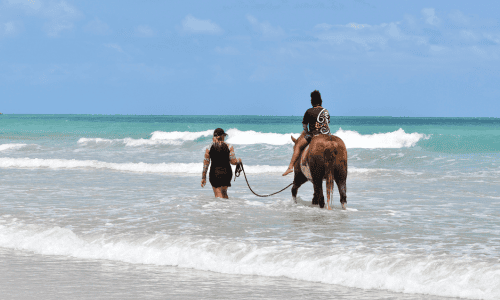
Yawardani Jan-ga is based in Broome and operates on a three-part model: program delivery, research and evidence building, and workforce development. Aboriginal community members are trained as equine-assisted learning practitioners, creating employment pathways, including for young people who once participated in the program themselves.
But ask Juli what happens in a session, and she will tell you the horses do most of the work.
“Horses are non-judgmental. They work on biofeedback. They don’t hold grudges. They live in the moment. They are like a mirror, they will reflect back what they pick up.”
That mirroring effect, Juli explains, is particularly powerful for young people who may struggle to verbalise what they are carrying. A horse does not ask you how you are doing and wait for a socially acceptable answer. It simply responds to what is true.
“If I ask a young person how they’re going today, they might say ‘great’ because they know if they say things are hard, I’m going to try to find out why. But they’ll come into the space with the horses and we don’t need to do all that. What we observe is what’s really going on for that young person. And that’s a really nice way into the conversation.”
For many participants, this creates a turning point. Juli recalls one young boy who came in nonverbal, struggling to regulate, unable to maintain friendships at school. After around 60 sessions over three years, something shifted. He returned to mainstream schooling. He no longer needed an aide. And one day, he ran in to tell Juli the news that had made everything feel possible.
“He said, ‘I’ve been invited to a party.’ He was 10 years old. He’d never been to a party. Never had a sleepover. He just couldn’t socialise in the way that was accepted. Now we see him out with friends playing footy.”
There are hundreds of stories like this. Juli says she cannot put into words the privilege of being part of young people’s lives in this way.
Yawarda: a name that carries significance
There is something else that sets Yawardani Jan-ga apart. It’s a detail that speaks to the depth of the program’s cultural grounding. Horses are not native to this country. They arrived with European colonisation, often associated with displacement and loss. And yet, in Juli’s language group Nyangumarta, horses have a word: yowda.
“My grandmother told me: the fact that horses have a word carries significance, that they were important enough to give a name. Not like a motor car, which just got sort of rolled into language, horses got a proper word. So even though they’re introduced animals, they carry meaning.”
That word, yawarda, carries through the Pilbara and the Kimberley across different language groups. It is there in the program’s name, and in its ethos: that healing can be found in unexpected places, and that communities themselves carry the wisdom to recognise it.
The program’s Cultural Governance Committee, six strong community leaders including Auntie Di Appleby, a Yawdru Elder from Broome and a mentor to Juli, ensures this integrity is never compromised. As Juli puts it, the work is owned by community, led by community, and will remain that way.
A film that tells a different kind of story
When filmmaker Sean O’Reilly first heard about Yawardani Jan-ga, he was not looking for an Indigenous story. He was looking for something else: a compelling, cinematic story about the relationship between humans and animals, set in the Australian landscape.
He found it when he and his partner, cinematographer Sophie, listened to Professor Juli Coffin speak on a podcast.
“We were looking at what do we think is a uniquely compelling story in a place that we’d love to tell it. And we landed on this.”
Sean and Sophie spent over 100 days in Broome filming sessions with participants, following wild Brumbies on the saltpans, and working closely with Juli. The result is Guided by Horses, due for general release in September 2026 following an initial community screening in Broome in May.
From the beginning, Sean was clear about the kind of film he wanted to make and the kind he would not.
“In documentary filmmaking, often with Indigenous stories around the world, we’re shooting problems, we’re shooting issues but we’re not talking about solutions. That’s what the market is saying to us is unique about this film: it’s about a solution.”
He is not wrong. Films that lead with deficit, trauma, or spectacularised suffering are plentiful. Films that trust communities to lead their own stories, that imagine their audiences might sit together and feel something uplifting are rare.
Sean describes the film as meditative and reflective, with an orchestral score by composer Caitlin Yeo, timed to the rhythm of the Kimberley landscape.
“I’ve had people say they lay down with their thoughts for a long time after watching it. It’s a really wholesome, uplifting experience you could watch with anyone, friends, family, anyone.”
He says the film has one message for educators, medical professionals, and policymakers who might see it: there are pathways to supporting young people that do not look like standard interventions. That connection to nature, to place, to relationship, offered through horses, through community, through the guidance of people like Juli Coffin, can do what a classroom or a clinic sometimes cannot.
A solution that is working
Yawardani Jan-ga was designed and implemented by Aboriginal community members who understood the barriers to education their young people faced better than any outside agency could. It does not impose a framework; it grows from one. It does not approach young people as problems to be fixed; it recognises them as people with strengths to be drawn out.
That is the principle at the heart of locally led development and it is the principle that Mary MacKillop Today has sought to live by as a partner since the program’s earliest days.
Juli says the partnership has evolved significantly: from that first grant that got the concept off the ground, to a collaborative relationship that has helped navigate the entirely new territory of running a charity, building an evidence base, and telling the program’s story to donors and the wider world.
“I can’t really say it enough – the gratitude that we feel for people like Mary MacKillop Today, who sit alongside us, walk the path with us, and see the vision. Without that pivotal starting point, we would not have been able to have a space in over 3,500 Aboriginal young people’s lives.”
This NAIDOC Week, we are proud to walk that path. And we are excited for the moment, coming soon, when the rest of Australia gets to meet Yawardani Jan-ga through the screen.
Rise With Courage – together
Mary MacKillop Today partners with Yawardani Jan-ga as part of our commitment to supporting First Nations-led programs that address the real barriers to education, wellbeing, and thriving in communities across Australia.
If you would like to support this work and help more young Aboriginal Australians thrive:
Guided by Horses is due for general release in September 2026. All quotes are drawn from interviews conducted by Mary MacKillop Today in 2026.