


Mohammad Altaf Afridi’s account of the Islamabad mechanics’ association is worth sitting with. It is a vivid, honest portrait of what civil society actually looks like when it grows from the ground up – messy, accountable to its members, and completely invisible to the donors writing the cheques. His critique lands and much of it is deserved.
But there is a risk in how this argument travels. Read one way, it suggests that international NGOs are the problem and that civil society would be healthier if the sector stepped back entirely. That conclusion, however understandable, would do real damage. And it would hit hardest in the places where civic space is already most constrained.
The critique is valid. The target is not.
Afridi is right that decades of proposal-driven, English-language, short-cycle funding created NGOs that were accountable to donors rather than communities. The “usual suspects” he describes as polished, networked, and performing civil society for visiting dignitaries, are a real phenomenon, and not unique to Pakistan.
But the solution to bad practice is reform, not retreat. Civil society, including international NGOs working in genuine partnership, provides an irreplaceable function in development systems. Where governments are unable or unwilling to serve their own citizens, where markets have no incentive to reach the most marginalised, it is civil society that fills the gap. Weaken it, and you do not liberate grassroots organisations. You simply leave communities without support in contexts where the state is not coming to help.
Australian NGOs are listening and the system is beginning to shift
The picture Afridi paints of USAID-era funding is not the whole story of how international development is practised today and certainly not in Australia. The Australian NGO sector operates under a rigorous accreditation system administered through the Department of Foreign Affairs and Trade. Independent evaluations consistently find that accredited NGOs deliver cost-effective, locally responsive programming, and reach communities that bilateral aid channels often cannot.
Crucially, Australian NGOs are not immune to the critique but still, many are actively working to address it. There is a genuine, sector-wide shift underway toward localisation: longer funding cycles, flexible core funding, direct partnerships with grassroots organisations, and community-led program design. The Australian NGO Cooperation Program (ANCP), which channels funding directly to accredited NGOs and their local partners, received a $7 million increase in the most recent federal budget. In a global environment where aid budgets are contracting sharply, Australia’s sustained commitment to development funding matters.
What genuine partnership looks like
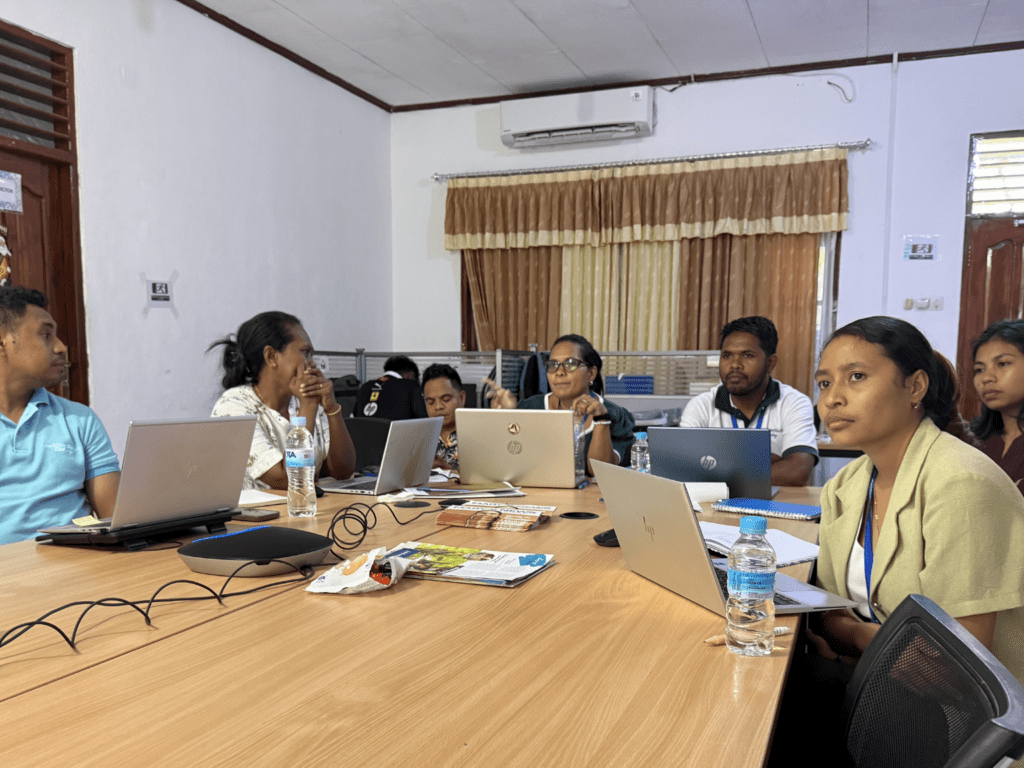
At Mary MacKillop Today, we work in Timor-Leste, Fiji, and with First Nations communities in Australia. Our programs are not short-term interventions designed around donor reporting cycles. Every new program begins with six months of community-led design, where the communities we work with define the outcomes, not us. Our funding cycles run for five years. The difference that makes to accountability is significant: when a community has been involved in designing what success looks like, they have real standing to hold us to it.
This is not a model we invented. It is one we have developed through long-standing relationships with local partner organisations who have taught us what genuine collaboration requires. Recently, at a sector event we helped convene with Women in Aid and Development, our partner organisation in Fiji – the Psychiatric Survivors Association – described how we work together as a model for what the relationship between an international NGO and a local organisation should look like. That discussion did not happen because we had good intentions. It happened because we had put in the years.
Sera Osbourne, Project Officer from Psychiatric Survivors Association explained, “They asked us how we wanted to be supported at an organisational level, and at a personal level, this empowered us to feel confident in making the organisation grow and meet the requirements and due diligence of other partners.
One year funding is not enough to implement any project in any thematic area, it is not enough to make a change in any community. All of the wish list we had when working with partners came true when we started working with Mary MacKillop Today. Members benefitted, the organisation grew and staff members improved in carrying out the work.”
Shift power – don’t remove actors
The real reform agenda is not about removing international NGOs from development systems. It is about repositioning them. International NGOs should be facilitators, not implementers, using their access to capital, networks, and institutional knowledge to strengthen locally led systems rather than substitute for them. That means increasing flexible, multi-year funding. It means supporting local organisations to build the institutional infrastructure they need without forcing them to become proposal-writing machines. It means sitting with discomfort when community priorities do not align neatly with donor frameworks.
Afridi is right that donor money “has a way of changing what it touches.” That is precisely why the sector needs to be more deliberate, not less present. The answer to funding that distorts is funding that is redesigned. The answer to NGOs that are accountable to the wrong people is structural reform that realigns that accountability. The answer is not to leave communities without partners in systems that were never designed with them in mind.
Caitlin McGrath, Programs Director, Mary MacKillop Today says, “At a point in time where the world seems to be in constant crisis, the sector needs to strengthen its parts that are truly working – enabling power to shift to local actors, with international NGOs in a position to listen and learn from those who knows best.”
The mechanics in that Islamabad market were doing something remarkable. They deserved better from the international development system than to be looked past. But they also deserve a development system that is reformed rather than dismantled, one where the power sits closer to them, and where the organisations working alongside them are accountable, first and foremost, to the communities they serve.