

When we talk about education activists, we tend to think of recent names. People who built platforms, wrote books, gave TED talks. We don’t often reach back 160 years to a young woman in a converted stable in South Australia, standing in front of children who had been told their education didn’t matter.
We should because Saint Mary MacKillop of the Cross, Australia’s first saint, was also, by any honest accounting, its first education activist. And on 8 August, her feast day, it is worth understanding what that actually means. Not as a devotional exercise, but as a provocation. Because the barriers she was fighting in 1866 have not disappeared. They have simply changed address.
What she was up against
When Mary MacKillop opened her first school in Penola in 1866, the children who filled it were not the children anyone else was fighting for. They were the children of families experiencing poverty, families who could not pay fees, who lived too far from existing schools, whose circumstances placed them outside the system’s interest.
The system, such as it was, had decided these children were not worth teaching. Mary MacKillop had a different view. She and Father Julian Tenison Woods established a school in a building her brother had converted from a stable, and she began. Within years, she had grown a following who became known as the Sisters of Saint Joseph. The Sisters and Mary opened schools across South Australia, Queensland, New South Wales, and beyond, reaching into remote communities, rural areas, and places no teacher had travelled before.
She was not doing this from a position of comfort or authority. She was doing it on almost nothing, with the constant threat of institutional opposition, including, famously, excommunication by the Bishop of Adelaide in 1871. She was reinstated within months and she kept going.
What she understood, and what she refused to pretend otherwise about, was this: education is not a reward for the right circumstances. It is a right. And when any system denies it to some children while offering it to others, something is broken.
The barriers she fought
Mary MacKillop’s work confronted four structural barriers to education that were keeping children out of classrooms in 19th century Australia. All four of them are still operating today.
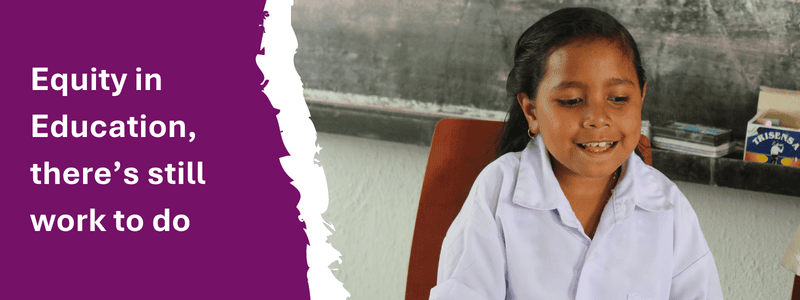
Poverty. Mary’s first students were the children of families who could not afford to pay for schooling. Today, across the world, poverty remains the most consistent predictor of whether a child will access quality education. In Timor-Leste, one of Australia’s closest neighbours, less than an hour’s flight from Darwin, around 42% of children live below the poverty line. Families make daily decisions between food and the expense of going to school, between keeping children at home to help earn income or sending them to a classroom.
Geography. Mary and the Sisters travelled to communities that existing schools had not reached, remote, rural, dispersed communities that were simply too inconvenient for the system to serve. In Timor-Leste today, mountainous terrain, unpaved roads, and scattered villages mean that geography is still one of the most powerful forces keeping children away from classrooms. Schools exist, but reaching them requires something close to an act of will.
Disability. Mary MacKillop’s approach to education was not selective. She believed every child deserved to learn, a position that was not self-evident in 19th century Australia, and is still not universally practised today. In Timor-Leste, one in five children with disability cannot access education at all. Classrooms are not designed for them. Teachers have not been trained to include them. The resources they need do not exist. The result is that some of the children most determined to learn are the ones most systematically denied the opportunity.
Gender. Girls in Mary’s time faced a world that consistently deprioritised their education. She taught them anyway. In places like Peru, Fiji and Timor-Leste today, girls still face compounding disadvantages. Their gender dictates their purpose and value in a community and often their voice is still not represented in civil or political environments. The data bears this out, and the stories behind the data are not abstract.
Timor-Leste Education Program
Since 2017, Mary MacKillop Today has been working in Timor-Leste on what is now called the Education program. Under this banner there are several projects designed to address one of the most persistent problems in the country’s education system: low rates of literacy and numeracy, and classrooms that are not equipped to include every child.
The program does not parachute solutions in from outside. It works through the people who are already there.
Teachers in target schools receive professional development training in child-friendly and inclusive teaching methods, practical, hands-on training that builds both their skills and their confidence. Teacher learning circles are established at each school, creating communities of practice where educators can share what works, troubleshoot what doesn’t, and keep improving together. Demonstration lessons are held in classrooms, so teachers can observe techniques in action before being expected to implement them. Parents receive reading awareness sessions, because learning doesn’t stop when children leave the classroom, and families who understand how to support learning at home become part of the solution. And teachers receive quality learning resources in Tetun, the local language, because teaching in a language children can access is not a luxury, it is a prerequisite.
This financial year, the program is reaching an estimated 39 schools and approximately 300 teachers. Those teachers, in turn, reach thousands of students and families.
What Mary MacKillop would recognise
It would be easy to frame Mary MacKillop’s work as something belonging to another era, admirable in its time, but safely historical. That framing is wrong, and it lets us off the hook.
The children she was teaching in 1866 were excluded from education by their poverty, their location, their circumstances, and the indifference of a system that had decided they were not worth the effort. The children the Inclusive Early Education Project is reaching in Timor-Leste in 2026 are excluded from education by their poverty, their location, their disability, and a system that has not yet built the capacity to include them.
The injustice is the same. The response is the same. What changes is the name of the person doing the work and the name of the country where the work is being done.
Mary MacKillop didn’t lobby for reform from a safe distance. She didn’t write position papers about the importance of education equity. She went to the places others weren’t going, with the resources she had, and she started. That is not a historical anecdote. It is a model.
On 8 August, we celebrate her feast day under the banner of this year’s campaign: Fierce for Fair. The phrase is borrowed from her — from a life that was both of those things, relentlessly and simultaneously. She was fierce about fairness in a way that cost her enormously, and she did it anyway, because she believed every child had a right to learn.
The work is not finished. Here is what you can do.
273 million children around the world are currently out of school. In Timor-Leste, only 20% of preschool-aged children are enrolled in early education. Around 70% of Grade 1 students do not meet basic learning outcomes. These are not distant statistics, Timor-Leste is one hour’s flight from Australia.
Mary MacKillop Education Program is working to change this, one teacher, one classroom and one parent at a time. But the work requires support to continue and to scale.
A gift to Mary MacKillop Today this August can help train a teacher to include children with disability in every lesson. It can help provide the learning materials children need to participate. It can help a parent understand how to support their child and help to open a classroom door for those who have never entered.
It is the same work Mary MacKillop started in 1866. It is not finished.
She was fierce. She was fair. Now it’s your turn.
marymackilloptoday.org.au/donate
#FierceForFair | Feast Day 8 August 2026