
In Timor-Leste, one of Australia’s closest neighbours, only one in five preschool-aged children is enrolled in school. By Grade 1, around 70% of students are not meeting basic learning outcomes. The foundations for lifelong learning are missing before formal school even begins.
Over the past year, Mary MacKillop Today’s Early Learning Project has been implemented at almost one-third of Timor-Leste’s government preschools. By the end of this year, we are on track to reach two-thirds nationally. This transformation has been built by something that rarely makes it into impact reports. It is the result of an effective relationship built with care, over more than a decade based on shared values.
A Relationship built on shared values
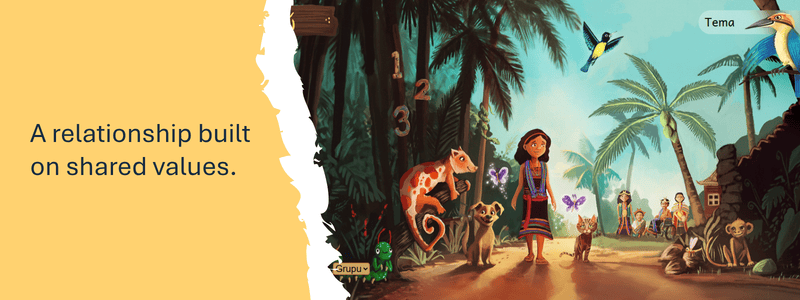
Mary MacKillop Today’s partnership with the Noel & Carmel O’Brien Family Foundation began in 2010, grounded in common values and a shared commitment to education in Timor-Leste. In 2022, the Foundation brought a bold question: could locally designed learning tools close the early education gap? The answer came through genuine partnership. We engaged World Mosaic, global education specialists, to work alongside our Timor-Leste team in a human-centred design process. Crucially, the Ministry of Education, teachers, parents, and students led the solution. The result: two complementary resources, to help teachers deliver curriculum-aligned, play-based lessons, and an app for parents to reinforce learning at home. Both are built entirely in Tetun, reflect Timorese culture and curriculum, and run offline to serve communities with limited connectivity. The tools are designed for shared, interactive learning between children, teachers, and parents, not isolation. This approach avoids individual child use altogether, instead creating moments of connection and guided discovery.
What made this work was trust, not just funding. It would be tempting to credit the size of the gift, but what made the project work was the open, honest, and authentic relationship built between donor and implementer. From the outset, we were transparent with the O’Brien Foundation about how funds would be used and managed. We were clear that our Timorese team would lead design and delivery. Technical support from World Mosaic was critical, but they took their lead from local experts. Rather than push back on this approach, the Foundation embraced our track record and stepped back from project decisions. Importantly, that trust ran both ways. The Foundation’s confidence encouraged us to think beyond our normal scale and seriously consider becoming a national implementing agency across all eight of Timor-Leste’s municipalities.
At points, the Foundation, coming from a commercial background, sought faster scale and lighter-touch implementation. Our instinct, grounded in our Timorese team’s experience, was to go slower and deeper, building quality before reach. Holding that position required confidence in our own evidence and the patience for the Foundation to test it against theirs. Implementation delays slowed the pilot at points. Rather than managing around these as failures, both sides treated them as opportunities to innovate or deliberately pause and ensure the path to scale was right, not just fast. That discipline mattered profoundly. It is easy to talk about trust when everything is on schedule. The real test is whether that trust holds when it is not. The evidence speaks for itself. The pilot reached six preschools, 500 children, and 300 homes by July 2025.
Results included increased student participation, deeper parent engagement, and an unintended but welcome outcome – increased student attendance. On the strength of that evidence, we have now scaled to 100 schools and around 9,000 children, teachers, and parents across the nation. More significantly, we are preparing the Ministry of Education employees to take ownership of the learning software on their own servers. The app framework will be released under open licence and freely available for other countries to adapt and build their own culturally grounded learning tools at far lower cost and in far less time.
What This Means for Australian Development Practice
Our experience offers a model for ethical, effective partnership:
Local expertise must lead. Decades of experience, combined with world-class delivery partners, provided the technical credibility that anchored this work. But the local team set the direction.
Trust compounds over time. Smaller, earlier projects with the O’Brien Foundation became the foundation for trust. Each delivered proof of our competence and integrity before the transformational grant came.
Transparency about what is not working matters more than celebrating what is. The willingness to be honest about delays and course corrections is what determines whether trust survives contact with implementation.
Donors need both heart and evidence. Foundations approach giving with both personal values and a business mindset, weighing sustainability and scalability alongside social impact. Communications and reporting need to speak to both.
This partnership demonstrates what Australian-funded, locally-led development can look like in practice. It is not about control masked as partnership. It is about genuine trust and a willingness to fund the work without directing it, and to create the conditions for innovation and deep collaboration to occur. Foundation Director Brendan O’Brien remains personally invested in the project’s next chapter, facilitating introductions within his networks and is currently visiting Timor-Leste. This is the kind of sustained engagement that only happens when a partnership has been built with care.
If you are interested in supporting locally-led, ethically grounded development work that creates lasting change, we would welcome a conversation.
If you would like to further support our work in Timor-Leste please donate or get in touch.